
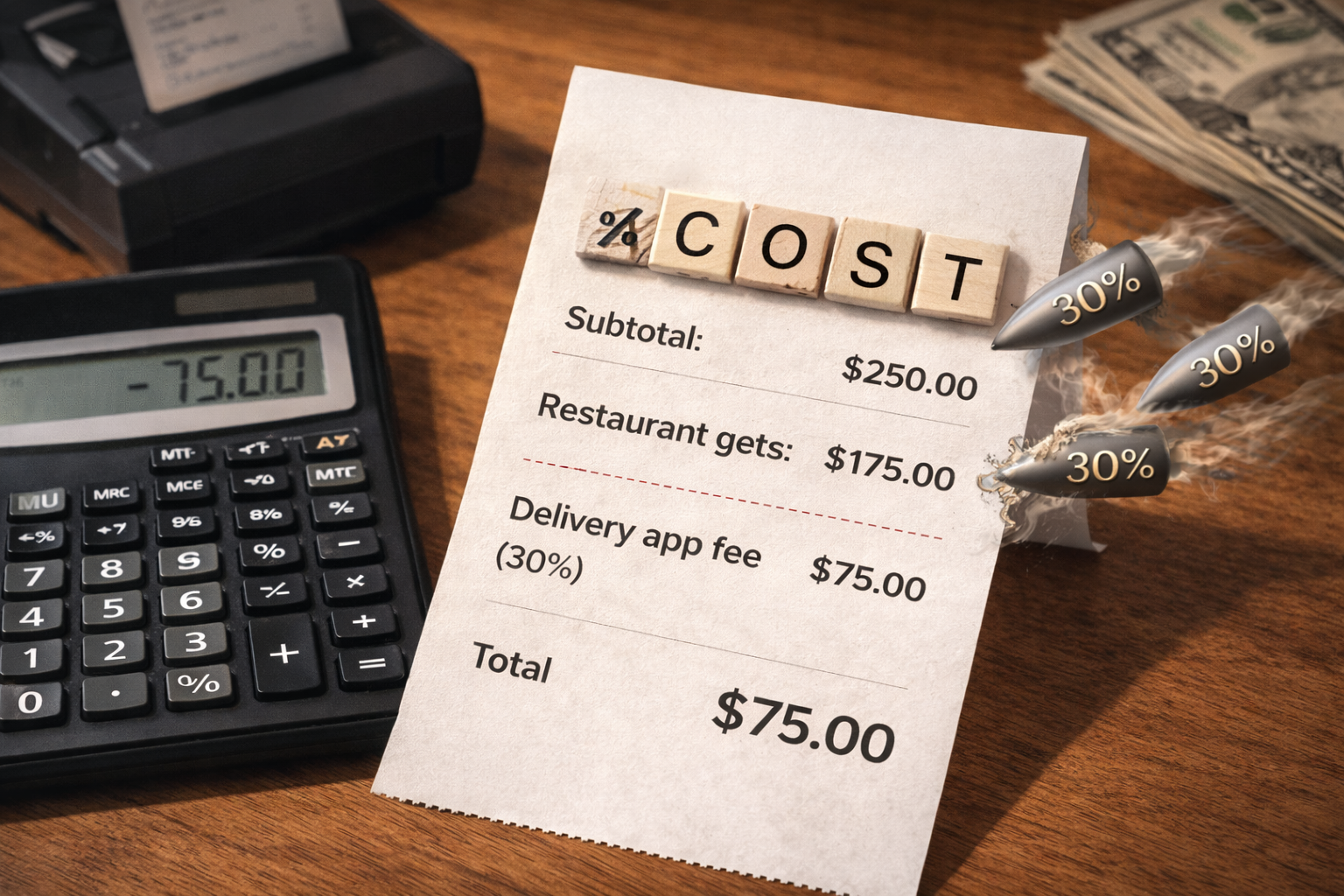
How Much Are Third-Party Delivery Apps
Really Costing Your Restaurant?
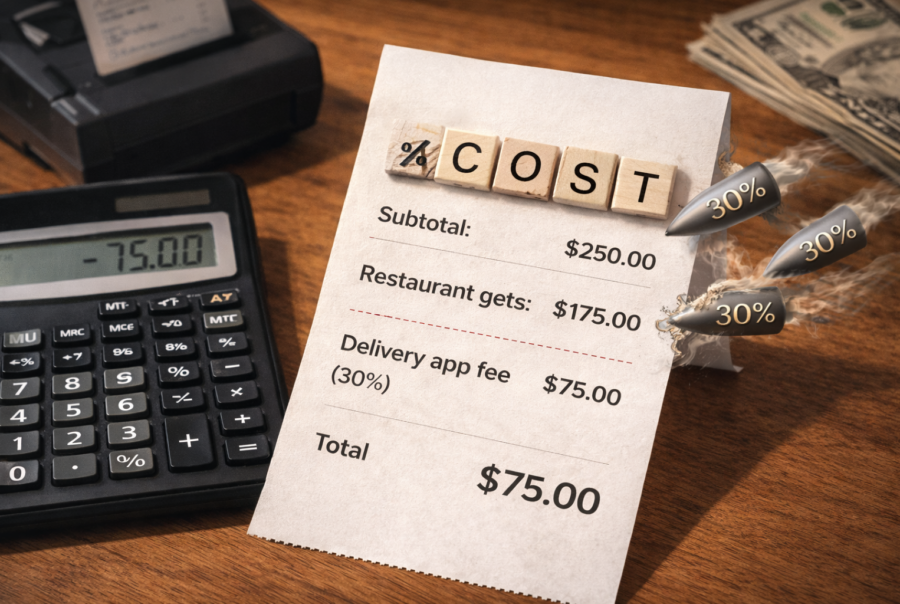
You already know DoorDash, Uber Eats, and Grubhub charge commission fees. But when you actually run the numbers on what those fees add up to over a month, a quarter, or a year — the amount is staggering.
Let’s break it down.
The Commission Structure
Third-party delivery platforms charge restaurants a percentage of every order. The rates vary depending on the platform, your agreement, and the level of visibility you’re paying for:
- DoorDash: 15% for basic listings, up to 30% for premium placement and DashPass inclusion. Pickup orders through DoorDash Storefront are commission-free, but delivery orders still carry 8–12% fees.
- Uber Eats: 15% for pickup, 30% for delivery with their drivers. Uber Eats also charges a 6% “marketplace fee” on some plans.
- Grubhub: 15–25% depending on your plan, plus additional fees for marketing and promoted listings.
These percentages are taken off the total order amount — including taxes and fees in some cases.
Let’s Do the Math
Say your restaurant does $8,000/month in third-party delivery orders — a pretty common number for a busy independent restaurant.
At a 25% average commission rate:
$8,000 × 25% = $2,000/month in commission fees
That’s $24,000 per year going straight to the delivery platform — not to your kitchen, your staff, or your bottom line.
Now consider that restaurant profit margins typically run between 3–9%. On $8,000 in orders, your profit might be $400–$720. But you’re paying $2,000 in commission. You’re losing money on every delivery order.
Even at a lower 15% rate, that’s still $1,200/month or $14,400/year.
The Hidden Costs Beyond Commission
Commission is just the starting point. There are other costs that don’t show up on the rate card:
Menu inflation. Many restaurants raise their prices 15–30% on third-party platforms to cover the commission. Customers notice — and some order less because of it, or leave bad reviews about pricing.
Lost customer relationships. When a customer orders through DoorDash, DoorDash owns that customer. You don’t get their email address, you can’t send them push notifications, and you can’t build loyalty with them directly. They’re DoorDash’s customer, not yours.
Promotion pressure. Platforms push you to offer discounts, free delivery, and promoted listings — all of which cost you more money. Saying no means less visibility on the platform.
Delivery quality you can’t control. A cold burger or a spilled drink from a careless driver results in a bad review on your restaurant — not on the delivery platform. Your reputation takes the hit for someone else’s mistake.
Tablet clutter. Every platform requires its own tablet or integration. More tablets means more things that can go wrong, more orders to manage manually, and more room for errors.
What Does Direct Ordering Look Like Instead?
When customers order through your own app or website instead of a third-party platform, the economics flip:
- No commission fees. You pay a flat per-order fee (on Gegsy, that’s as low as $0.20 per pickup order on the Pro plan) instead of a 15–30% cut.
- You own the customer relationship. You get their contact info, order history, and the ability to market to them directly with push notifications and promo codes.
- Delivery still works. Platforms like Gegsy use Nash and DoorDash Drive for delivery fulfillment — you get professional drivers without the marketplace commission.
- Your brand, not theirs. Customers order from an app and website that looks like yours, reinforcing your brand instead of the platform’s.
The Real Comparison
Let’s compare the same $8,000/month in orders:
| Third-Party (25%) | Gegsy Pro ($99/mo) | |
|---|---|---|
| Monthly orders | $8,000 | $8,000 |
| Commission/fees | $2,000 | ~$200 (flat per-order fees) |
| Monthly subscription | $0 | $99 |
| Total cost | $2,000 | ~$299 |
| You keep | $6,000 | ~$7,701 |
| Annual savings | — | ~$20,400 |
That’s over $20,000/year back in your pocket.
Even on Gegsy’s Basic plan at $19/month with slightly higher per-order fees, the savings are dramatic compared to third-party commissions.
You Don’t Have to Quit Cold Turkey
Here’s the practical approach: you don’t need to leave DoorDash or Uber Eats overnight. They can still be useful for discovery — new customers finding you for the first time.
But once a customer has ordered from you, steer them to your direct channels:
- Put a flyer in every delivery bag that says “Order directly from us next time — download our app or visit [your storefront link].”
- Add your storefront link to your Google Business Profile so customers who search for you can order directly.
- Use push notifications and promo codes through your Gegsy app to incentivize repeat direct orders.
Over time, as your direct ordering grows, your dependence on high-commission platforms shrinks — and your margins improve dramatically.
The Bottom Line
Third-party delivery apps served a purpose — they introduced your restaurant to new customers and made delivery accessible during a time when it was desperately needed. But the 15–30% commission model was never designed to be sustainable for restaurants.
In 2026, you have better options. A branded mobile app and web storefront through Gegsy gives your customers a way to order directly from you — on any device, at any time — without the middleman taking a cut.
👉 See how much you could save by switching to direct ordering with Gegsy.
Ready to try Gegsy?
Sign up risk-free and launch your branded mobile app within 24 hours.
No setup fees. No long-term contracts.


